Skip to content
Menu

Review

Kajabi review

By Marcus Reeve, reviewed by the Lander Report editors. Updated 2026-09-28. How we research

Our verdict

Kajabi is real. It is the established, default platform for coaches and course creators, with more than 100,000 businesses on it and no cut taken from your sales. You would regret it as an affiliate buying paid traffic: the product is built to host and sell your own courses, memberships and coaching, not to spin up fast landers or run the ad-safe split tests that protect a Meta or Google campaign. It is also expensive, from $143/mo on the annual plan. Buy it if you sell your own courses or coaching and want a website, email, checkout and course delivery in one system. Skip it if you just need a lander and a same-URL A/B test.

Who this is for, in one line

You have heard the name. Kajabi runs on half the coaching webinars you have sat through, and a friend swears by it. The question underneath "should I buy it" is really two questions: is it a real, safe product, and will I regret the money. This review answers both for someone buying paid traffic, because that is who reads this site.

The short version: it is real and well established, and for its intended buyer it is a good tool. That buyer is a coach or course creator selling their own knowledge, not an affiliate sending cold clicks to a lander. If that is not you, the price and the missing ad-testing features will bite.

What Kajabi actually is

Kajabi calls itself the platform for experts. In plain terms it is a single system for building, marketing and selling your own knowledge products: online courses, memberships, coaching programs, communities, podcasts and newsletters. Around that sit the sales tools, a website builder, landing pages, funnels, email marketing and automations, checkout, and analytics, plus a growing set of AI features it markets as Cofounder and Expert Agents.

Read that list and notice the order. Kajabi leads with what you sell and how you deliver it. The page builder and the funnel are supporting cast. That single fact answers most of the question a paid-traffic buyer is really asking, and it is why the tool sits near the bottom of our ranking for this audience while being an obvious pick for its own.

Is it real, or hype?

It is real. Kajabi has been around since 2010, and the vendor reports more than 100,000 businesses on the platform, over 75 million customers served and more than $12B earned by creators using it. Those are the company's own figures, so read them as scale rather than proof of results, but the track record is not in doubt. This is not a thin product that appeared last year.

Independent sentiment is more mixed than the marketing. Trustpilot sits around 3.4 to 3.5 out of 5 across more than 2,000 reviews, with praise for the connected setup and complaints about price, support and the editor. That is a normal spread for a platform this size, and it is worth more than the testimonial reel on the home page. The honest read: the company is safe to trust, and the regret risk is about fit and cost, not about the product vanishing on you.

Where it fits if you buy traffic

Here is the split that decides whether you regret this purchase. If your job is to send a paid click to a page and get a conversion on someone else's offer, and delivery is not your problem, this is the wrong shape of tool. You are paying for a course platform, a membership engine and a community you will never open. A dedicated landing page builder will ship a faster page and a cleaner test for less money.

If you sell your own offer, the maths changes completely. When the click has to become a course sale, a coaching booking, a membership signup or a recurring subscription, and you want the email follow-up, the checkout and the delivery in one place, Kajabi does all of it and keeps none of the sale. For a creator running their own knowledge business, that consolidation is the reason to be here. One long-time user put the trade-off well:

"What shifted it for me was realizing the comparison isn't really about features, it's about how long it takes to actually launch. Piecing together Teachable plus email plus funnels is cheaper on paper, but the setup time adds up fast." r/onlinecourses

Split testing: read the fine print

This is the feature this site weights above all others, so it gets its own section. Kajabi has landing pages and funnels, and you can build and publish pages inside it. What it does not advertise is same-URL, server-side split testing: the mechanism that rotates variants behind a single ad destination so Meta and Google do not reset the campaign's learning phase when you test.

For a coach driving warm traffic from email and social, that gap does not matter. For a media buyer whose margin is conversion rate minus click cost, it is the difference between a test that pays for itself and one that spikes your click cost. If ad-safe testing is your top requirement, this is not the tool, and no amount of other features closes the gap. Course platforms in general are built this way, as one creator noted:

"The thing with course builders is that none of them (except to an extent LearnWorlds) have good page builders. That's not really their focus. They kind of expect that you're going to host the front-end website/landing page somewhere else anyways." r/onlinecourses

What buyers say, in their words

The positive case is easy to find, and it is consistent: Kajabi is the default for coaches, and people stay for the connected system rather than any single standout tool. A coach in r/lifecoaching summed up the mixed feeling most long-time users land on:

"It's expensive but it's the main go to platform for coaches. I like the website builder but I'm not crazy about the course builder" r/lifecoaching

The critical case is specific and it repeats. The loudest complaint is price against a course-only use. The second is the editor. A user in r/edtech who came from Squarespace was blunt:

"coming from squarespace, Kajabi is such a terribly ugly and out of date platform that I feel like I am wading through mediocrity every time I use it. It has tons of features, but is clueless about user experience." r/edtech

Both pictures are true at once. A capable, connected platform that its own users find dated to work in and expensive to justify unless they use the whole thing.

Pricing across the tiers

Kajabi has three self-serve plans. Prices below are for annual billing, with the higher monthly rate in brackets. Kajabi raised prices in Q4 2025, effective for existing customers from January 2026, so any older review you read is likely quoting stale numbers.

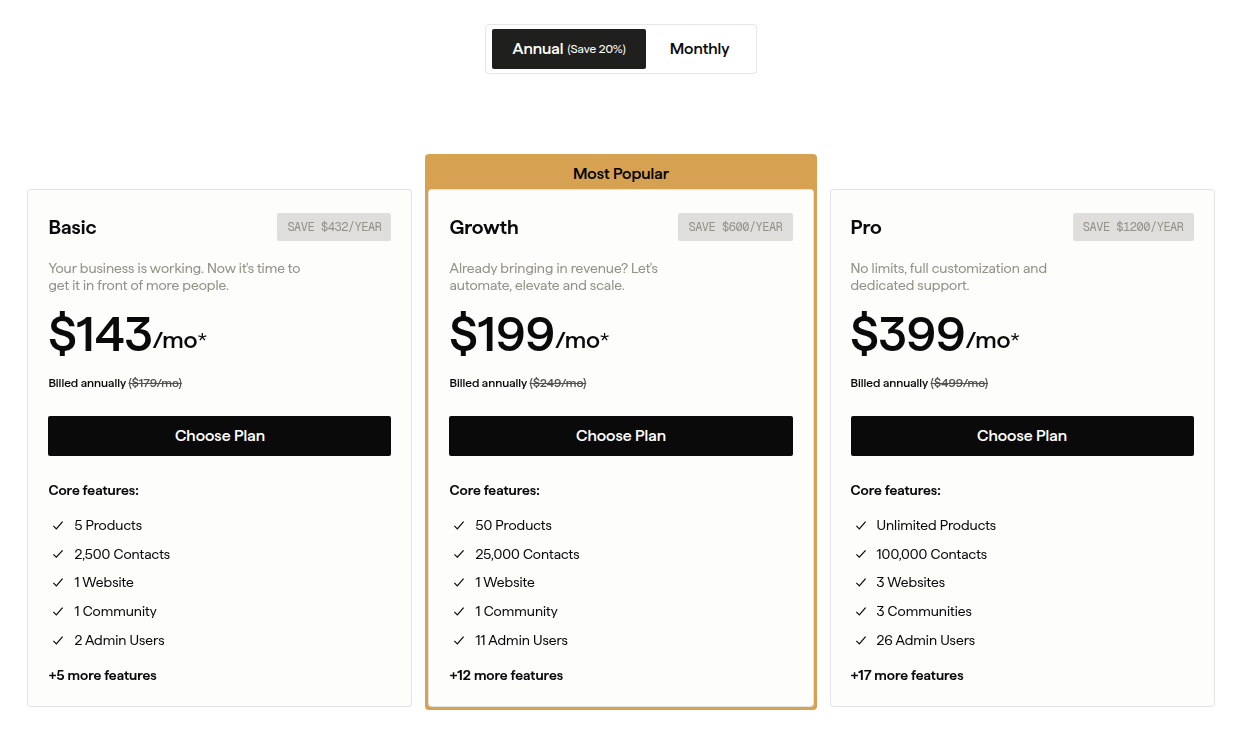
  • Basic, $143/mo ($179 monthly). 5 products, 2,500 contacts, 1 website, 1 community, 2 admin users. For a creator with one offer getting it in front of more people.
  • Growth, $199/mo ($249 monthly). 50 products, 25,000 contacts, 11 admin users, plus advanced automations and the option to remove Kajabi branding. This is the plan most established creators land on.
  • Pro, $399/mo ($499 monthly). Unlimited products, 100,000 contacts, 3 websites, 3 communities, 26 admin users, a branded mobile app and API access. For multiple brands or anyone who wants their own app.

Two things to keep straight. Kajabi keeps no revenue share, which genuinely sets it apart from marketplaces that skim every sale. But card processing still applies: 2.9% + $0.30 on Basic, 2.8% on Growth and 2.7% on Pro through Kajabi Payments, and using a third-party processor adds a 2% / 1% / 0.5% platform fee by tier. Extra contacts come in blocks of 25,000 for $125/mo. The 30-day free trial requires a card and auto-bills when it ends, so set a reminder if you are only testing.

Changelog

  • 2026-09-28: First published. Pricing verified against the Kajabi pricing page (Basic $143, Growth $199, Pro $399 on the annual plan) on 2026-09-27, reflecting the Q4 2025 increase. User sentiment drawn from Reddit and Trustpilot as of this date.
What works

  • It genuinely replaces a stack, and takes no revenue share. One subscription covers courses, coaching, communities, memberships, a website, landing pages, email, automations and checkout, and Kajabi keeps none of what you sell beyond standard card processing (2.7 to 2.9% plus $0.30). For a creator selling their own offer, that consolidation is the point.
  • It is established and low-risk to trust. The vendor reports over 100,000 businesses and more than $12B earned on the platform, and long-time coaches call it the default. You are not betting on an unknown or a brand-new product with no track record.
  • It is fast to launch and to follow up. Users who justify the price say the win is speed: a product, a sales page, an email sequence and a checkout live in days, backed by newer AI tools that draft the setup for you.

What to watch

  • It is a course and coaching platform first, not a lander tool. Landing pages and funnels are included, but page building is not its focus, and it does not offer the same-URL, server-side split testing that keeps Meta and Google ad learning intact. A paid-traffic affiliate who needs ad-safe A/B tests will not find them here.
  • It is expensive, and the most common complaint is price against a course-only use. Plans start at $143/mo billed annually and reach $399/mo, and users say that fee only pays off if you actually run the marketing and sales side, not just course hosting.
  • The editor frustrates power users, and the platform is sticky. Long-time users call the page and checkout editor unintuitive and dated with limited customization. Once your site, list, products and automations live inside Kajabi, moving out is painful, which makes the monthly fee harder to walk away from.
Kajabi's three plan cards with an annual/monthly toggle: Basic at $143/mo, Growth at $199/mo and Pro at $399/mo billed annually, each listing product, contact, website, community and admin-user limits.
Transparent plan pricing. Kajabi's three plan cards with an annual/monthly toggle: Basic at $143/mo, Growth at $199/mo and Pro at $399/mo billed annually, each listing product, contact, website, community and admin-user limits. Screenshot: kajabi.com,

What users actually say about Kajabi

Research: unverified

It is real and it is the default for coaches

Users repeatedly call Kajabi the go-to platform for coaches and course creators, and the vendor's own numbers (100K+ businesses, $12B+ earned) back a long track record. The praise is for the connected setup, not for any one best tool.

“What shifted it for me was realizing the comparison isn't really about features, it's about how long it takes to actually launch. Piecing together Teachable + email + funnels is cheaper on paper, but the setup time adds up fast. Kajabi makes more sense if you're trying to get something live in the next 60–90 days. If you're still in testing mode, probably not worth it yet.”

Anonymous Reddit: Kajabi free trial vs $99 for 3 months

“It's expensive but it's the main go to platform for coaches. I like the website builder but I'm not crazy about the course builder”

Anonymous Reddit: Is anyone here using Kajabi

The recurring complaint is price versus a course only use ↓ common complaint

The loudest and most consistent complaint is that Kajabi is overpriced if you treat it as a course builder. Users say the marketing and sales side is where the money goes, and the fee only makes sense when you actually use the whole stack.

“Kajabi is super overpriced for how limited it's course building features are. Admittedly it's better in the marketing/sales side of things, but the price just doesn't justify it IMO.”

Anonymous Reddit: Kajabi free trial vs $99 for 3 months

“What shifted it for me was realizing the comparison isn't really about features, it's about how long it takes to actually launch. Piecing together Teachable + email + funnels is cheaper on paper, but the setup time adds up fast. Kajabi makes more sense if you're trying to get something live in the next 60–90 days. If you're still in testing mode, probably not worth it yet.”

Anonymous Reddit: Kajabi free trial vs $99 for 3 months

The page and course editor frustrate power users ↓ common complaint

Multiple users describe the editor as unintuitive and dated, with limited control over buttons, text and checkout pages compared with WordPress or Squarespace. Page building is not what Kajabi is built around.

“coming from squarespace, Kajabi is such a terribly ugly and out of date platform that I feel like I am wading through mediocrity every time I use it. It has tons of features, but is clueless about user experience.”

Anonymous Reddit: Are you using Kajabi? What are the most annoying things

“Buttons, CTA's, text... everything is hard to edit or preview. It fails miserable when compared to Wordpress, which is amazing in how it handles edits, themes and previews.”

Anonymous Reddit: Are you using Kajabi? What are the most annoying things

“The thing with course builders is that none of them (except to an extent LearnWorlds) have good page builders. That's not really their focus. They kind of expect that you're going to host the front-end website/landing page somewhere else anyways.”

Anonymous Reddit: New course creator: all-in-one vs piecing it together

What Kajabi costs

Basic $143/mo billed annually ($179 monthly), Growth $199/mo annual ($249 monthly), Pro $399/mo annual ($499 monthly). Kajabi takes no revenue share. Card processing on Kajabi Payments runs 2.9% + $0.30 (Basic), 2.8% (Growth) and 2.7% (Pro); a third-party processor adds a 2% / 1% / 0.5% platform fee by tier. 30-day free trial, card required.

. Prices verified 2026-09-27.

Frequently asked questions

How much does Kajabi cost?
Basic $143/mo billed annually ($179 monthly), Growth $199/mo annual ($249 monthly), Pro $399/mo annual ($499 monthly). Kajabi takes no revenue share. Card processing on Kajabi Payments runs 2.9% + $0.30 (Basic), 2.8% (Growth) and 2.7% (Pro); a third-party processor adds a 2% / 1% / 0.5% platform fee by tier. 30-day free trial, card required. Prices checked 2026-09-27.
Does Kajabi have a free trial?
30-day free trial, card required.
Is Kajabi a good landing page tool for affiliates?
Kajabi is real. It is the established, default platform for coaches and course creators, with more than 100,000 businesses on it and no cut taken from your sales. You would regret it as an affiliate buying paid traffic: the product is built to host and sell your own courses, memberships and coaching, not to spin up fast landers or run the ad-safe split tests that protect a Meta or Google campaign. It is also expensive, from $143/mo on the annual plan. Buy it if you sell your own courses or coaching and want a website, email, checkout and course delivery in one system. Skip it if you just need a lander and a same-URL A/B test.

Sources

From Kajabi

Other sources

6 discussions and reviews read for this page. Quotes are excerpts; open a link to read the original in context.

  1. [oc-price] Kajabi free trial vs $99 for 3 months Reddit
  2. [oc-launch] Kajabi free trial vs $99 for 3 months Reddit
  3. [lc-goto] Is anyone here using Kajabi Reddit
  4. [et-ux] Are you using Kajabi? What are the most annoying things Reddit
  5. [et-edit] Are you using Kajabi? What are the most annoying things Reddit
  6. [oc-pages] New course creator: all-in-one vs piecing it together Reddit

Keep reading

Marcus Reeve

Written by

Marcus Reeve

Editor

Marcus leads the rankings at Lander Report. He reads the long threads where media buyers argue about which builder survives a Meta review and which one resets their ad learning, works through the vendors' own docs and pricing pages, and verifies every price before it goes in a table. He writes the roundups and the head-to-heads, and he cares most about one question: does a test cost you your campaign's learning phase?

marcus.reeve@landerreport.com

Last checked 2026-09-28