Who this is for, in one line
You have seen CartFlows recommended in every WooCommerce thread, usually as the cheap way to get ClickFunnels-style upsells without paying ClickFunnels money. The question underneath "should I buy it" is really two questions: is it a real, safe product, and will I regret the money. This review answers both for someone buying paid traffic, because that is who reads this site.
The short version: it is real, it is widely used, and for its intended buyer it is a good deal. That buyer runs their own WordPress and WooCommerce store and sells their own products. If that is not you, the WordPress overhead and the missing ad-safe testing will bite before the low price helps.
What CartFlows actually is
CartFlows is a plugin, not a hosted platform. It installs on your own WordPress site, sits on top of WooCommerce, and replaces the default WooCommerce checkout with a proper sales funnel: an optimized checkout page, order bumps at the point of purchase, one-click post-purchase upsells and downsells, custom thank-you pages, funnel-step A/B testing and built-in analytics. You build the pages with a page builder you already know, Elementor, Bricks, Divi, Beaver Builder or the block editor, and payments run through your existing WooCommerce gateway.
Read that again and notice the boundary. CartFlows is a checkout-and-funnel layer. It is not a website host, not an email tool and not a CRM. It assumes you already run a WordPress store and just want the buying steps to convert harder. That single fact answers most of what a paid-traffic buyer is really asking, and it is why the tool sits near the bottom of our ranking for this audience while being an obvious pick for its own.
Is it real, or hype?
It is real. CartFlows launched in 2018 and is built by Brainstorm Force, the same team behind the Astra theme, which runs on millions of WordPress sites. The vendor reports 800,000+ active stores across its plugin suite, and the free CartFlows plugin on WordPress.org carries a 4.8 out of 5 rating from roughly 486 reviews across 200,000+ active installs. This is not a thin product that appeared last year, and it is not going to vanish on you.
Independent sentiment is more split than that headline rating suggests, and the split is informative. The WordPress.org score reflects people who installed a free plugin and got a working checkout. Trustpilot and Capterra, which capture the billing and support experience, run harder on the company. The honest read: the product is safe to trust and the software mostly does what it says. The regret risk is about fit, support and price creep, not about the thing being fake.
Where it fits if you buy traffic
Here is the split that decides whether you regret this purchase. If your job is to send a paid click to a landing page and get a conversion on someone else's offer, and you never collect the payment yourself, CartFlows is the wrong shape of tool. It only earns its keep at the checkout, and you do not have one. You would also be taking on a whole WordPress and WooCommerce stack, hosting, updates, security and all, to get a lander a hosted builder would ship in an afternoon. For that reader, a dedicated landing page builder is faster and cleaner.
If you sell your own product and already live in WordPress, the maths flips. When the click has to become a purchase you fulfil, and you want order bumps, one-click upsells and a checkout that does not look like stock WooCommerce, CartFlows adds exactly that for a flat annual fee and takes none of your sales. Compared with a hosted funnel platform like ClickFunnels at $97 a month and up, a one-time or annual plugin licence is a fraction of the cost over a year. That price gap is the whole reason CartFlows exists, and reviewers who run stores back up the payoff:
"Nearly 40% of customers were clicking order bump boxes, instantly increasing revenue on those sales by almost 50%." BloggingX
Split testing: read the fine print
This is the feature this site weights above all others, so it gets its own section. CartFlows does have A/B split testing, and it is a genuine feature: you create variations of a funnel step, it splits traffic between them, and it reports which converts better. For a store owner optimising a checkout, that is useful and it works.
What it is not is the same-URL, server-side rotation that a media buyer leans on. The mechanism that protects a Meta or Google campaign is one that rotates variants behind a single ad destination so the platform does not reset the campaign's learning phase when you test. CartFlows runs its tests on your own WordPress pages at the funnel-step level, and it is not marketed as that ad-learning-safe rotation. If your top requirement is testing cold paid traffic without spiking click costs, do not assume this covers it, and design any test carefully. Tools built specifically for that, like Unbounce with Smart Traffic, are a different category of thing.
What buyers say, in their words
The positive case is consistent: CartFlows is the affordable way to get a real checkout funnel inside WooCommerce, and people who set it up correctly stay. A G2 reviewer put the core value plainly:
"CartFlows lets you build a checkout sequence, and it's great at enabling you to do that." G2
The critical case is specific and it repeats, and almost none of it is about the software. The loudest complaints are support and billing. Trustpilot reviewers describe slow responses and friction getting a refund or cancelling, in blunt terms:
"Terrible customer service." Trustpilot
The second recurring theme is the setup itself. Because CartFlows lives inside your own WordPress, a funnel can collide with your theme or another plugin, and getting it wired correctly takes some patience. A Capterra reviewer named the trade-off:
"some plugin conflicts with other plugins that we had to find a solution for" Capterra
Both pictures are true at once. A capable, affordable checkout funnel that most people get working, wrapped in a company whose support and billing draw real frustration, running on a WordPress stack you are responsible for.
One more limit worth naming
CartFlows stops at the checkout. There is no built-in email marketing, no CRM and no cart-abandonment recovery in the core funnel builder, so following up with a buyer or winning back an abandoned cart means adding more plugins (the vendor sells its own Cart Abandonment Recovery add-on, and bundles it into the pricier Suite). If you want one login that also handles email, contacts and automation, a single platform that bundles all of it will feel less like assembling parts. On WordPress itself, FunnelKit is the closest alternative, folding email, SMS and a contact CRM into the same funnel plugin. If you already have your email tool and just want the checkout to convert, that gap does not matter.
Pricing across the tiers
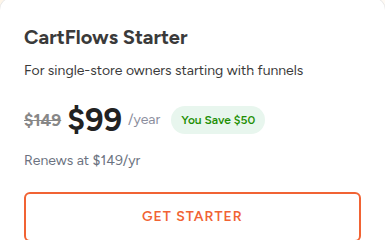
CartFlows sells the Funnel Builder on annual plans, with a free version on WordPress.org as the on-ramp. The prices below are the introductory annual rates, and the catch is in the renewal, so read both numbers.
- Free on WordPress.org. Build simple funnels and try the flow. As one reviewer put it, "the paid version does the actual work", so treat the free tier as a taste rather than the tool.
- Starter, $99/year intro, renews at $149/year. One website, the funnel builder, checkout and thank-you pages.
- Pro, $199/year intro, renews at $299/year, or $699 one time for a lifetime licence. Three websites, plus dynamic order bumps, one-click upsells, smart funnel routing and A/B testing. This is the plan most stores actually want.
- Suite, $299/year intro, renews at $449/year, or $999 one time. Thirty websites and five extra plugins bundled in, including Cart Abandonment Recovery, Modern Cart and Power Coupons.
Two things to keep straight. CartFlows takes no cut of your sales, unlike a marketplace, which genuinely sets a self-hosted plugin apart. But there is no time-limited free trial; instead you get a 14-day money-back guarantee, so you buy first and request a refund if it is wrong for you, and reviewers report that getting that refund is not always smooth. Whatever intro price you pay, budget for the renewal, because it is meaningfully higher.
Changelog
- 2026-09-28: First published. Pricing verified against the CartFlows pricing page (free version, Starter $99, Pro $199, Suite $299 on annual intro rates, renewing higher) on 2026-09-28. User sentiment drawn from G2, Trustpilot, Capterra and independent reviews as of this date.