Who this is for, in one line
You have probably seen FunnelKit recommended in WooCommerce and WordPress threads as the plugin that gives you ClickFunnels-style checkouts and upsells without paying a monthly SaaS bill, and maybe under its old name, WooFunnels. The question underneath "should I buy it" is really two questions: is it a real, safe product, and will I regret the money. This review answers both for someone buying paid traffic, because that is who reads this site.
The short version: it is real, it is widely used, and for its intended buyer it is one of the better deals on WordPress. That buyer runs their own WooCommerce store and sells their own products. If that is not you, the WordPress overhead and the funnel-step-only testing will bite before the low price helps.
What FunnelKit actually is
FunnelKit is a plugin, not a hosted platform. It installs on your own WordPress site, sits on top of WooCommerce, and turns the plain WooCommerce buying flow into a real sales funnel: an optimized single or multi-step checkout, order bumps at the point of purchase, one-click post-purchase upsells and downsells, a sliding cart, opt-in and thank-you pages, funnel-step A/B testing and revenue analytics. You build the pages with a page builder you already know, Elementor, Divi, Gutenberg and others, and payments run through your existing WooCommerce gateway.
Where it goes further than a plain checkout plugin is the second half of the product, FunnelKit Automations (formerly Autonami). On the higher plans it adds email and SMS broadcasts, a visual automation builder, cart-abandonment recovery and a 360-degree contact profile that works as a light CRM. So FunnelKit is two things fused: a checkout and funnel layer, and a marketing-automation engine, both living inside WordPress. That combination is the whole argument for it, and it is what separates it from a checkout-only plugin like CartFlows.
Is it real, or hype?
It is real. FunnelKit has been around for years, first as WooFunnels and rebranded to FunnelKit in 2022, and it is a registered trademark of Wisetr INC. The vendor reports more than 40,300 stores using it, and the free Funnel Builder plugin on WordPress.org carries a 4.9 rating with a large review count. This is not a product that appeared last year, and it is not going to disappear on you.
Independent sentiment is more split than that headline rating suggests, and the split is informative. The WordPress.org score reflects people who installed a free plugin and got a working checkout. The billing and support experience, captured on Trustpilot and in support threads, runs harder in places. The honest read: the product is safe to trust and the software mostly does what it says. The regret risk is about fit, support and price creep, not about the thing being fake.
The part that sets it apart
Most self-hosted funnel plugins stop at the checkout and leave email and follow-up to you. FunnelKit does not. Its automation engine can recover an abandoned cart by email and SMS, run post-purchase sequences, and segment contacts by past purchases and order value, all from the same dashboard as the checkout. For a store owner who otherwise pays for a checkout plugin plus a separate email tool plus a cart-recovery add-on, folding those into one licence is a genuine saving and one less set of integrations to maintain.
Two caveats keep that honest. The automation and CRM only appear on the Professional plan and up, so the cheaper tiers are checkout-only. And a light contact CRM inside WordPress is not the same as a dedicated email platform at scale; if list management is your core job, a purpose-built tool will still do more. As a bundled convenience for a store that mainly sells, though, it is a real advantage.
Where it fits if you buy traffic
Here is the split that decides whether you regret this purchase. If your job is to send a paid click to a landing page and get a conversion on someone else's offer, and you never collect the payment yourself, FunnelKit is the wrong shape of tool. It earns its keep at the checkout and in follow-up, and you have neither. You would also be taking on a whole WordPress and WooCommerce stack, hosting, updates and security included, to get a lander a hosted builder would ship in an afternoon. For that reader, a dedicated landing page builder is faster and cleaner.
If you sell your own product and already live in WordPress, the maths flips. When the click has to become a purchase you fulfil, and you want order bumps, one-click upsells, cart recovery and a checkout that does not look like stock WooCommerce, FunnelKit adds all of that for a flat annual fee and takes none of your sales. Compared with a hosted funnel platform like ClickFunnels at $97 a month and up, an annual plugin licence is a fraction of the cost over a year, and it is the reason FunnelKit exists.
Split testing: read the fine print
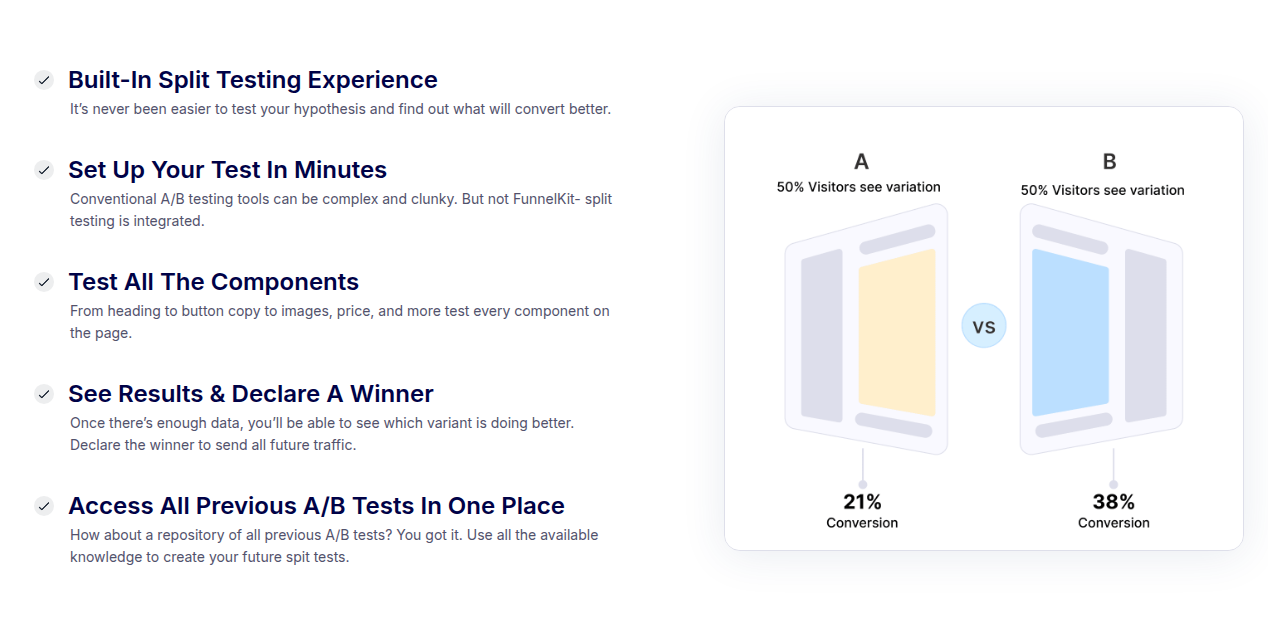
This is the feature this site weights above all others, so it gets its own section. FunnelKit does have A/B split testing, and it is a genuine feature: you create variations of a funnel step, it splits traffic between them, reports which converts better, and lets you declare a winner to send all future traffic there. For a store owner optimising a checkout or a sales page, that is useful and it works.
What it is not is the same-URL, server-side rotation a media buyer leans on. The mechanism that protects a Meta or Google campaign rotates variants behind a single ad destination so the platform does not reset the campaign's learning phase when you test. FunnelKit runs its tests on your own WordPress pages at the funnel-step level, and it is not marketed as that ad-learning-safe rotation. If your top requirement is testing cold paid traffic without spiking click costs, do not assume this covers it, and design any test carefully. Tools built specifically for that, like Unbounce with Smart Traffic, are a different category of thing.
What buyers say, in their words
The positive case is consistent: FunnelKit is the affordable way to get a real checkout funnel and automation inside WooCommerce, and reviewers single out fast, thorough support. On WordPress.org it is described as an excellent plugin that handles checkout and marketing in one place, and on Trustpilot the praise repeatedly lands on support going, in one reviewer's words, "above and beyond."
"above and beyond" Trustpilot
The critical case is specific and it repeats, and almost none of it is about the software. The loudest complaints are billing and cancellation. One WordPress.org support thread is titled, bluntly, "Worst Ever Company," and a Trustpilot reviewer who tried to cancel describes being ignored until after the refund window had passed.
"Worst Ever Company" WordPress.org
The second recurring theme is that it is not plug and play. Independent reviewers rate FunnelKit highly but warn the automation side has a learning curve, and that configuring it well takes real work rather than a five-minute install.
FunnelKit is not "plug and play" and the automations take real setup work. WPBeginner
A third, quieter note from reviewers: features are gated by plan rather than unlocked for everyone, and stacking the plugins FunnelKit wants can slow a site down. Both pictures are true at once. A capable, affordable checkout-and-automation plugin that most people get working, wrapped in a company whose support and billing draw real frustration, running on a WordPress stack you are responsible for.
Pricing across the tiers
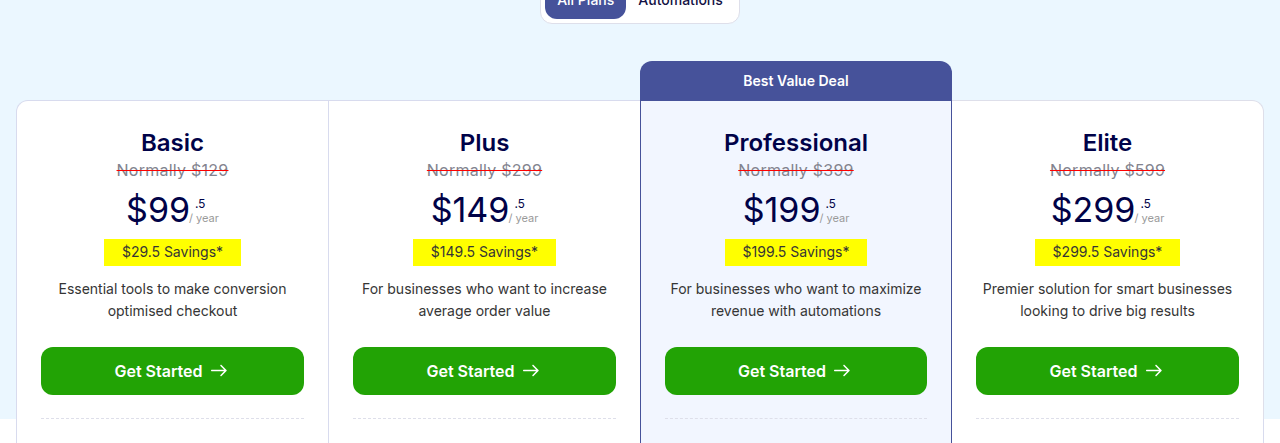
FunnelKit sells the Funnel Builder on annual plans, with a free version on WordPress.org as the on-ramp. The prices below are the introductory annual rates, and the catch is in the renewal, so read both numbers. All renewals are at full price.
- Free Funnel Builder Lite on WordPress.org. Build a basic checkout and try the flow. Treat it as a taste, not the finished tool.
- Basic, $99.50/year intro, renews at $129/year. One site, the optimized store checkout, thank-you pages and sliding cart. No funnels or upsells yet.
- Plus, $149.50/year intro, renews at $299/year. Two sites, and this is where the funnels, order bumps, one-click upsells and A/B testing switch on.
- Professional, $199.50/year intro, renews at $399/year. Three sites, and it adds the email and SMS automations, broadcasts and the contact CRM. This is the plan most stores actually want.
- Elite, $299.50/year intro, renews at $599/year. Thirty sites, everything above. There is also an Automations-only plan at $99.50/year intro if you want the marketing engine without the funnel builder.
Two things to keep straight. FunnelKit takes no cut of your sales, unlike a marketplace, which genuinely sets a self-hosted plugin apart. But there is no time-limited free trial; instead you get a 14-day money-back guarantee, so you buy first and request a refund if it is wrong for you, and reviewers report that getting that refund is not always smooth. Whatever intro price you pay, budget for the renewal, because it is meaningfully higher.
Changelog
- 2026-09-28: First published. Pricing verified against the FunnelKit pricing page (free version, Basic $99.50, Plus $149.50, Professional $199.50, Elite $299.50 on annual intro rates, renewing higher) on 2026-09-28. User sentiment drawn from WordPress.org, Trustpilot and independent reviews as of this date.